

The Bonanno Crime Family

The Bonanno crime family is one of New York’s Five Families, the Mafia groups that have run organised crime in the city since 1931. Its roots lie in the Sicilian fishing town of Castellammare del Golfo, and it takes its name from Joseph Bonanno, who led it for more than thirty years. Based mainly in Brooklyn and Queens, it has been involved in gambling, loan-sharking, extortion, narcotics and labour racketeering.
🎁 The NCS Christmas Gift Guide
Gifts for the
Mob-History Fan
Real gangsters, gold Art Deco. Printed to order and shipped from a print partner near them.
Shop the gift guide →


Order printed gifts by 10 December for Christmas · Ships worldwide
It is also the family with the strangest history of the five: a boss who vanished, an internal war, a leader shot dead in a restaurant garden, an FBI agent who lived among its members for nearly five years, and the first sitting New York boss to testify for the government. This hub brings together every NCS article on the family.
Quick facts
| Founded | 1931, out of Salvatore Maranzano’s organisation |
| Named after | Joseph Bonanno, boss 1931–1968 |
| Base | Brooklyn (Williamsburg, Bushwick) and Queens |
| Roots | Castellammare del Golfo, Sicily |
| Key events | Castellammarese War (1930–31), Banana War (1964–68), Galante murder (1979), FBI infiltration (1976–81) |
| Expelled from the Commission | Early 1980s, after the FBI infiltration |
| Turning point | Joseph Massino convicted in July 2004, then cooperated with prosecutors |
| Status | Still active, according to federal prosecutors |
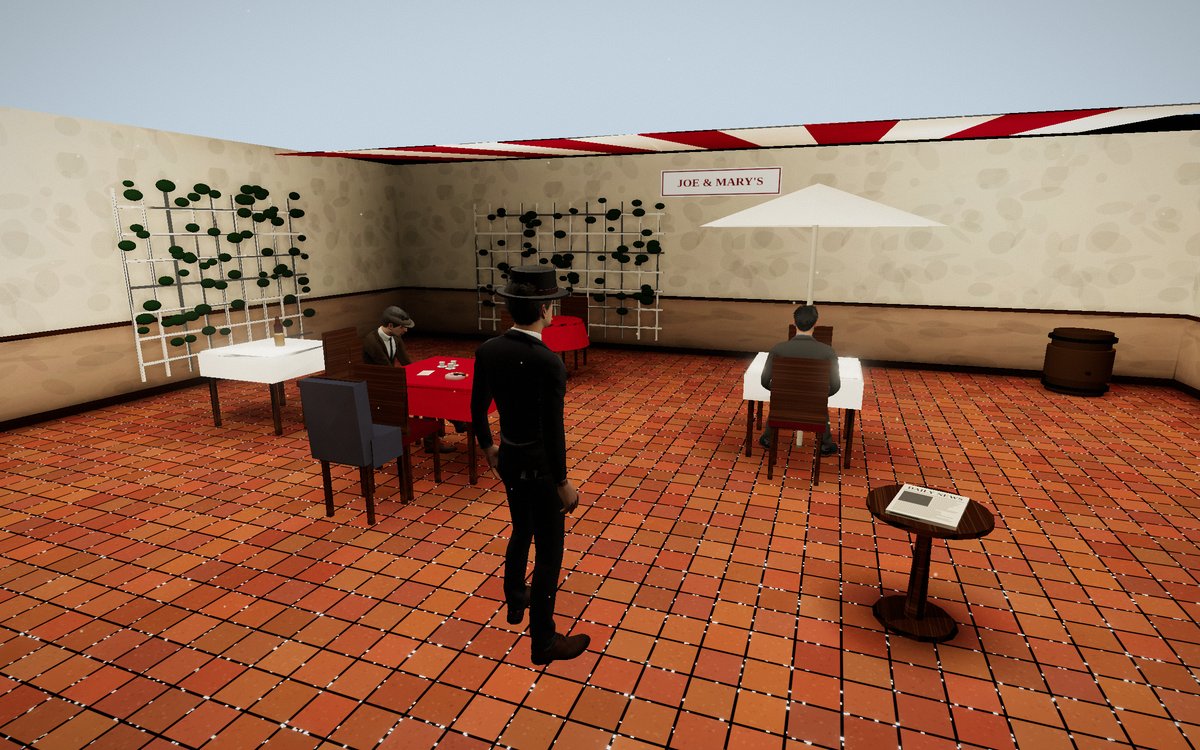
Joe and Mary's escape room
Bushwick, July 1979. Carmine Galante finishes lunch on the patio. Walk the scene in 3D, read the real evidence and crack the padlock before the clock runs out.
Play in your browser →No download. Works on phone and desktop. Or start free at the Ravenite.or get the app: App Store · Google PlayOrigins: Castellammare and the war of 1930–31
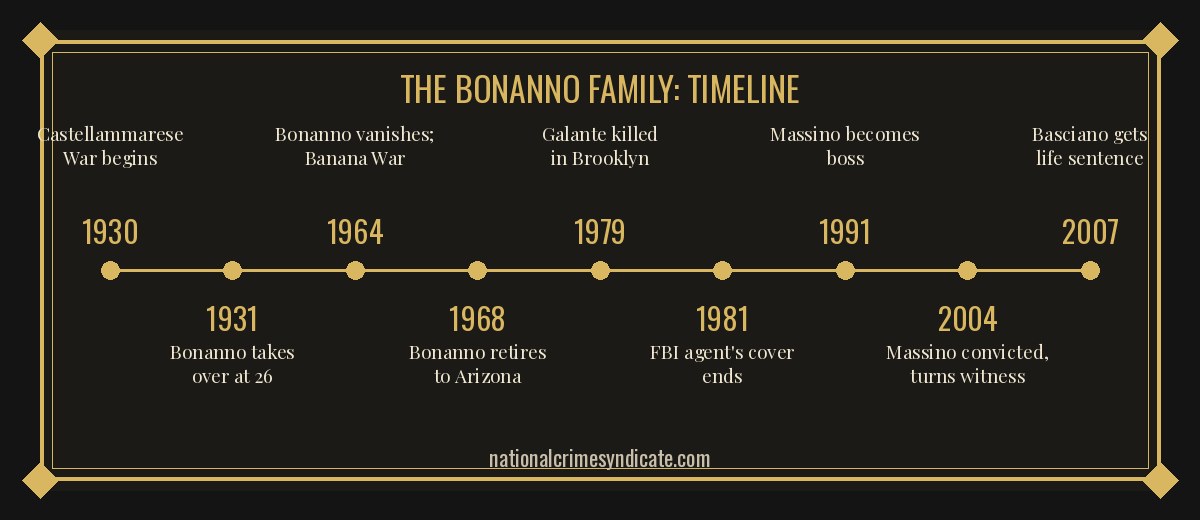
In the 1920s Brooklyn had a large community of immigrants from Castellammare del Golfo, and their Mafia group was led from 1930 by Salvatore Maranzano. That year Maranzano’s faction went to war with Joe Masseria, the most powerful boss in New York. The Castellammarese War ended on 15 April 1931, when Masseria was shot dead in a Coney Island restaurant, betrayed by his own men, including Lucky Luciano.

Maranzano declared himself “boss of bosses” and reorganised New York into five families. His reign lasted less than five months. On 10 September 1931 he was killed in his Manhattan office, a murder widely attributed to Luciano’s allies. Read more: Salvatore Maranzano, the boss of bosses, Joe Masseria, the boss who lost the war and Lucky Luciano.
Joseph Bonanno’s reign (1931–1968)
Born in Castellammare on 18 January 1905, Joseph Bonanno took over most of Maranzano’s family after the September 1931 murder, aged 26. That made him one of the youngest bosses in American Mafia history and gave him a seat on the Commission, the ruling body Luciano set up that year.

For three decades Bonanno ran a disciplined, tightly knit family with interests in Brooklyn, upstate New York, Canada and Arizona. Its members called it simply the family; the public only began using the name “Bonanno” after Joe Valachi’s televised Senate testimony in 1963 set out the structure of the New York Mafia. See: Joseph Valachi and the McClellan hearings.
That same year Bonanno made his biggest mistake. Working with Joseph Magliocco, who had succeeded Joe Profaci, he planned to have rival bosses Carlo Gambino and Tommy Lucchese killed. Magliocco gave the job to Joseph Colombo, who instead told the targets. The Commission forgave Magliocco and made Colombo boss of what became the Colombo family; see Joe Colombo. Bonanno was summoned to explain himself and did not come. Read the full biography: Joseph Bonanno, the godfather who built a dynasty.
The disappearance and the Banana War (1964–1968)
On 21 October 1964, when he was due to appear before a federal grand jury, Joseph Bonanno disappeared from a Manhattan street. His lawyer said he had been kidnapped. He stayed out of sight for nineteen months and walked into the federal courthouse at Foley Square on 17 May 1966.
While he was gone, the Commission recognised Gaspar DiGregorio as boss, and the family split into two camps: loyalists behind Bonanno and his son Salvatore “Bill” Bonanno, and those who followed DiGregorio. The newspapers called the shootings and feuding that followed the “Banana War”. The Commission later replaced DiGregorio with Paul Sciacca. The fighting ended in 1968, when Joseph Bonanno, after a heart attack, agreed to retire to Arizona. He settled in Tucson, where he died on 11 May 2002, aged 97.
Evola, Rastelli and Carmine Galante (1968–1979)
Sciacca led the family until 1971, followed by Natale Evola, who died in August 1973. In 1974 the family chose Philip “Rusty” Rastelli as boss. Rastelli spent much of the next seventeen years in prison, and the family was often run by others in his name.

The most feared of them was Carmine Galante. Released from prison in 1974, Galante made himself the family’s real power and, according to many accounts, set out to dominate the narcotics trade at the expense of the other families. On 12 July 1979 he was shot dead in the rear courtyard of Joe and Mary’s Italian-American restaurant on Knickerbocker Avenue in Bushwick, Brooklyn. Federal prosecutors later presented the killing as one approved by the Commission. Read more: Carmine Galante’s death.
The FBI agent inside (1976–1981)
From September 1976 the FBI had an agent working inside the family. Joseph Pistone, using the name “Donnie Brasco” and posing as a jewel thief, became a trusted associate of the crew run by Dominick “Sonny Black” Napolitano. The operation ran until July 1981, when the FBI pulled him out. His evidence fed into a long run of prosecutions of Bonanno members and associates.
The fallout inside the family was violent. On 5 May 1981 three captains, Alphonse Indelicato, Philip Giaccone and Dominick Trinchera, were murdered at a Brooklyn social club in a power struggle. That August, Napolitano, who had vouched for Pistone, was murdered too. The other families were so embarrassed by the infiltration that they expelled the Bonannos from the Commission. Read the full story: Operation Donnie Brasco: the FBI inside the Bonanno family.
Being off the Commission had one unexpected benefit. When the government brought the 1985–86 Commission Trial against the heads of the families, Rastelli was dropped from the case, and the bosses convicted in it came from the other families.
Joseph Massino: rebuilding and betrayal (1991–2004)
Rastelli died on 24 June 1991, and Joseph Massino, a captain from Queens, became boss. Massino rebuilt the family’s discipline and secrecy. He reportedly limited meetings, discouraged members from saying his name aloud and shut down the social clubs where the FBI liked to watch. By the late 1990s many law-enforcement officials regarded the Bonannos as the strongest of the five families. The family also returned to the Commission during this period.

The rebuild did not last. In the early 2000s a series of senior members, including Massino’s own brother-in-law, Salvatore Vitale, agreed to cooperate with prosecutors. Massino was arrested on 9 January 2003, and on 30 July 2004 a federal jury convicted him on all eleven counts, including racketeering charges tied to seven murders. Facing a possible death penalty case, he did something no sitting boss of a New York family had done before: he became a government witness. He secretly recorded his acting boss, Vincent Basciano, and later testified against him. Massino was resentenced to time served in 2013 and died in September 2023, aged 80.
Decline and the family today
Basciano led the family after Massino’s arrest until his own legal troubles caught up with him. In August 2007 he was convicted of murder and sentenced to life, and in 2011 he was convicted again, with Massino testifying against him.
Since then, prosecutors and the press have reported a family that is much reduced but still active. Michael Mancuso has been widely reported as its boss since around 2013, for much of that time from prison. Federal cases have continued: eight Bonanno members and associates were arrested on racketeering and extortion charges in January 2018, and in August 2022 prosecutors charged nine Bonanno and Genovese members and associates over gambling and money laundering. To compare it with the other families, see the Genovese family today and how a Mafia family is structured.
Bosses at a glance
| Years | Boss | Notes |
|---|---|---|
| 1930–1931 | Salvatore Maranzano | Killed 10 September 1931 |
| 1931–1968 | Joseph Bonanno | Disappeared 1964–66; retired 1968 |
| 1964–1966 | Gaspar DiGregorio | Recognised by the Commission during the split |
| 1966–1971 | Paul Sciacca | Accounts differ on his start date |
| 1971–1973 | Natale Evola | Died August 1973 |
| 1974–1991 | Philip Rastelli | In prison for long periods |
| 1976–1979 | Carmine Galante | Real power while Rastelli was jailed; killed July 1979 |
| 1991–2004 | Joseph Massino | Convicted 2004, then cooperated |
| 2004–c.2011 | Vincent Basciano | Acting boss; jailed for life |
| c.2013– | Michael Mancuso | Reported boss, not officially confirmed |
For the full year-by-year list, see the Bonanno crime family leadership timeline.
Related on NCS: The Commission · The Castellammarese War · Carlo Gambino · The ultimate Mafia glossary
The other families: The Gambino crime family · The Genovese crime family · The Lucchese crime family · The Colombo crime family · The Chicago Outfit
FAQs
What is the Bonanno crime family?
The Bonanno crime family is one of New York’s Five Families of the American Mafia. It grew out of Salvatore Maranzano’s Castellammarese organisation in 1931 and is based mainly in Brooklyn and Queens.
Why is it called the Bonanno family?
It is named after Joseph Bonanno, who led it from 1931 to 1968. The family names became public after Joe Valachi’s Senate testimony in 1963.
What was the Banana War?
The Banana War was the split and fighting inside the family between 1964 and 1968, after Joseph Bonanno disappeared and the Commission recognised Gaspar DiGregorio as boss. It ended when Bonanno retired to Arizona in 1968.
Why was the Bonanno family thrown off the Commission?
After FBI agent Joseph Pistone spent nearly five years inside the family as “Donnie Brasco”, the other families expelled the Bonannos from the Commission in the early 1980s. The family later regained its seat.
Who killed Carmine Galante?
Galante was shot dead at a Brooklyn restaurant on 12 July 1979. Federal prosecutors later treated it as a killing sanctioned by the Commission.
Who was the first New York Mafia boss to cooperate with the government?
Joseph Massino, boss of the Bonanno family, became a government witness after his conviction in July 2004. He was the first sitting boss of a New York family to do so.
Does the Bonanno family still exist?
Yes. Federal prosecutors still bring cases against its members, most recently on racketeering, gambling and extortion charges, though it is far smaller than at its peak.